Showing posts with label flexibility. Show all posts

Tuesday, 29 September 2020

Flexibility v Mobility + Consistency Over Intensity

 Flexibility vs Mobility


This explanation about the difference between flexibility and mobility from Chris Sommer was very good and to the point.


“Flexibility” can be passive, whereas “mobility” requires that you can demonstrate strength throughout the entire range of motion, including the end ranges.”


I find a lot of people say they have to work on their flexibility, which is true a fair amount of the time, but long term what they need is to increase their mobility. After a few weeks of stretching and gaining some flexibility I find they have to get stronger at those end ranges as mentioned above. People tend to over-do the flexibility and neglect the mobility in certain sports. There is an optimal level of flexibility needed for each sport, not a maximal level. Charles Poliquin taught me this a long time ago. For example, a rugby league player needs to be flexible but he doesn’t have to be as flexible as a gymnast.


Related article:

Will strength training affect my flexibility?


Consistency Over Intensity


Chris also has a good saying to remind athletes that adaptation takes time. He says “Slow down. Where’s the fire?” Adaptations from training can take weeks or months of consistent work. Gains don’t come linearly. You may see next to no progress for a while and then all of a sudden your strength seems to go through the roof all of a sudden or you pick up a skill you had been working on for a long time. It is like something just clicks. Sometimes you just have to be patient.


If you rush you increase your risk of injury. You want to coax the body into building strength or muscle mass not force it. So from one workout to the next we may only increase the load by 1kg but it doesn’t matter you are still adapting and making your way towards your goal. By doing this consistently you can maintain technique and eventually you will have increased the load significantly. If you add 5kg to the bar each workout it will not take very long before you are grinding reps, hitting a plateau, and injuring yourself.


Ed Coan spoke of this at great length in a seminar when talking about longevity in powerlifting. It also applies to other sports. Basically what he said was you can have a long career through making gradual progress from session to session and comp to comp or you can go crazy, train 3 times a day, get really quick results, but only have a short career because you have ruined your body and can’t do your sport anymore.

Friday, 13 April 2018

Will Strength Training Affect My Flexibility?

Will Strength Training Affect My Flexibility?

April 18, 2016

Growing up I would hear things like “lifting weights will make you muscle bound and slow” or “going to the gym makes you tight and increases the chance of injuries”, l now know comments like this are not true. If you train correctly, strength training will increase your speed and can even enhance flexibility, not hamper it.

As early as 1956, Massey and Chaudet demonstrated that heavy resistance training does not cause a decrease in flexibility (Fleck). In 1987 others showed that weight training actually increased the range of motion of the ankle, trunk, and shoulder joint after 11 weeks of resistance training without any additional flexibility training.

The type of training program used and the initial flexibility level of an athlete influence the gains you can have in flexibility from resistance training. If an athlete comes in and is extremely tight then incorporating a flexibility program in conjunction with a resistance training program is in order. In this case resistance training alone may not get the athlete flexible enough to perform certain movements safely or perform better in their chosen sport. The type of program will also dictate the amount of flexibility gained from resistance training with Olympic lifters displaying greater ranges of motion than say a powerlifter. This makes sense when you look at the two sports and see the degree of flexibility that is required to perform a snatch in comparison to a bench press. There is an optimal amount of flexibility needed for every given sport, you don’t always need or want maximal flexibility.

Muscle hypertrophy may decrease flexibility in some instances. This could be the case if someone had an extremely large chest and tried to touch their elbows in front of them. While I do believe hypertrophy may affect flexibility I think that most times it is because no attention is paid to maintaining or increasing flexibility in this group of athletes more so than hypertrophy being the only cause. Imbalance between the agonist and antagonist is also another reason for this decrease in flexibility in my opinion so it is important to look at program design to maintain or optimize flexibility.

If you are looking to maintain or increase flexibility with strength training alone, than training through the full range of motion is extremely important. This seems like common sense but what most people I see in a public gym consider full range of motion is a joke.

Resistance training and flexibility training complement one another. Charles Poliquin has said that stretching is the yin to strength trainings yang. Flexibility training may increase functional range of motion while strength and power training helps to improve the control of that functional range of motion.

So generally strength training will either improve or show no change in flexibility. If you want to enhance flexibility you have to train it like everything else. As muscle hypertrophy increases you may have to pay attention to flexibility training. Balance between the strength of agonist and antagonist has to be monitored and using a full range of motion will help improve gains in flexibility and performance. If you want the best results combine a strength training program with a flexibility program.

Friday, 1 September 2017

Hamstring Tear - Quick Recovery

Hamstring Tear - Quick Recovery


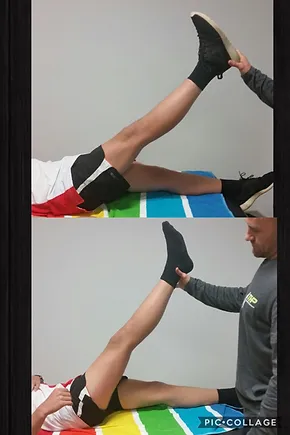
Tristyn Ball came and seen us after tearing his hamstring a few weeks back. The photo is the increased range of motion he gained in just one session and it was only two days after doing the injury. 

He had rugby league semi-finals coming up in a few weeks time and wanted to make sure he was back for them. We got him in, had a bit of a look at his hamstring and done some work on it, gave him some strength training to do, some stretches for his tight hip flexors and hamstrings, changed his nutrition to address some nutritional deficiencies, and gave him a supplement protocol to help heal the tear. Two weeks later we followed up with his Dad to see how he was going and he told us he was already back to running at 100%. He made it back for the finals quite comfortably in the end. This was a great result and we only treated him one time. 

It is because we addressed many underlying issues. There is no one single approach that will get you back on the field as quickly as you would like. It takes a combination to beat the general recommendations of 4-6 weeks for an injury like this. This is why physio or other methods fall short at times. It is not that they don't work, it is because it is focusing on one issue. The more issues you can address, the quicker you can return to play. I have learnt what areas need to be addressed and how to apply them to an athlete who is desperate to compete in his sport. I have experienced many injuries myself and this has helped me a lot. 

If you need to return to the field of play quickly and conventional methods aren't working, or haven't worked for you in the past then it may be time to book in and address the underlying issues you have.

Related Articles: